Following yesterday's post about serialising some of John Cook's rebuttal pieces, the comments have persuaded me that I should continue putting them up in the shooting gallery.
But before I do, some other points and a request:
1. First, I need to make it clear that the comments I received privately were certainly not aimed at censoring Cook. But the depth of feeling in them clearly signalled that something has gone wrong in the academic debate on climate change.
2. As he himself says, Cook himself is not a climate scientist - his specialism is physics - and his site was set up pro bono by his lights as a convinced global warmist. Further, he says he "has no affiliations with any organisations or political groups." So he is not to be accused of having stymied anyone's career in climate science, or taking some rich man's shilling. When one glances around the internet he does seem to polarise (that wasnt intended as a pun) the participants, because of his (as some see it) excessive assertiveness; but one has to remember that Skeptical Science is intended for the public and so oversimplification is bound to be a hazard.
What gave me pause was the obvious - and surprising to me - strength of sentiment provoked by Cook, who appears to stand as a symbol of the triumphalism of the pro-warmist camp generally. And even in the comments to my related post yesterday, there are mutual insults and imputations of improper motive and so on. There is a level of tension that makes liberal suspension of judgement and bilateral respect very hard to sustain, and so I wondered whether it was worthwhile airing the discussion if all it achieved was to see the air thick with brickbats - "hooligan's confetti".
But this has led to another issue: what is causing this level of acrimony? There is smoke drifting over the hedge, and I'd like to see where the fire is.
I don't think it's just to do with disagreements over the truth. It's something to do with vested interests of various kinds, that's clear enough, and I'll be glad if anyone is willing to get down to specifics rather than generally tarring the other side as mercenary scoundrels.
That's my first request: specifics on conscious bias. While keeping an eye on libel laws, can anybody really show that soemone has sold their integrity, instead of simply being funded for an opinion they had anyway?
And my second is about bullying and skulduggery. What evidence (if any) is there that people on either side have been leaned on or otherwise unfairly treated for not toeing the line? Is there any case where fervent revolutionaries or cold reactionaries have gone too far, and (in career terms) employed Stalin's maxim "no man, no problem"?
If you feel you can help, please contact me in confidence at wved@ymail.com. It will be very useful in getting the background - or the underlay - to this most contentious subject.
All original material is copyright of its author. Fair use permitted. Contact via comment. Unless indicated otherwise, all internet links accessed at time of writing. Nothing here should be taken as personal advice, financial or otherwise. No liability is accepted for third-party content, whether incorporated in or linked to this blog; or for unintentional error and inaccuracy. The blog author may have, or intend to change, a personal position in any stock or other kind of investment mentioned.
Showing posts with label Sackerson. Show all posts
Showing posts with label Sackerson. Show all posts
Thursday, 19 September 2013

Wednesday, 18 September 2013
Should I continue to publish John Cook's Skeptical Science pieces?
I have an apology to make - I think.
On Monday, I commented on David Rose's piece in previous day's Mail on Sunday. His series has been tagged "The Great Green Con" and his contrarianism (with which I have no issue in principle, being awkward myself) has been expressed in a provocative style that may help sell newspapers but doesn't do much for the spirit of liberal debate. In fact Rose seems to go so far out of his way to rile that I mistakenly thought he might be Johann Hari, who did at one time use the name "David Rose"; I am sorry for the error, but I have little trust in newpapers any more and believe some of them capable of taking a black sheep back into the fold if it helps boost circulation. My bad, as the Americans say.
Rose's piece seized on the increase in Arctic ice cover as some sort of touchstone proof that the global warmists were wrong. So I cast about for some alternative explanation for this seemingly awkward fact. And came across a piece written by an Australian academic called John Cook, who described a plausible mechanism whereby ice at the other end of the world might be increasing as a result of global warming. He kindly agreed to let me republish here, and to use other material if I wished - and so I planned a series of his debunk-the-debunker pieces to run for a month or so, with the idea that it would stimulate and inform debate.
I didn't realize that I had gone pogo-sticking into a minefield.
Having left college nearly forty years ago, and only as a student, I had forgotten what I'd heard about how sharp academic controversy and rivalry can be. At Oxford, votes in the election of the University's Chancellor can be checked against the name of the voter, and careers have (it seems) come to a screeching, permanent halt just for backing the wrong candidate. I supported a friend in the last vote and found out from Who's Who that another candidate, Lord Blake, was also head of the Electoral Reform Society, which (I think) is in favour of secret ballots; my friend told me that when he was going round radio stations on the stump they treated him as an entertaining joke until he raised this point, and then he could hear the producer screaming "Cut!" into the interviewer's headphones.
Now it seems that climate change is an issue that can scarcely be discussed at all. Adherents on either side overstate their case and denigrate the opposition - deplorably like some of the politicians that infest our Mother of Parliaments. It was Andrew Neather who revealed that Labour was happy to encourage immigration partly because it would "rub the Right's nose in diversity" (though the implication of that metaphor is quite unpleasant, when you come to consider it).
Anyhow, it may well be that careers in science have also been blighted by backing the wrong candidate (would Richard Dawkins be fair to a Christian graduate student under his tutelage, I wonder; perhaps he would). And there's money in grants and lobbying to be had on both sides, too.
So the odium theologicum rages strong in this field. Alerted by very unhappy comment about John Cook, I looked for evidence that he is considered extremist or over-eager in his advocacy. His site (Skeptical Science) is certainly assertive, just as Rose's articles are, and really I've been brought up to think that science is always tentative and provisional. And so like Rose (who I think is not himself a scientist, though he has chosen a scientific subject) he invites debunkers.
Which is what I was hoping for. A backs global warming, B rejects the theory, C (Cook) tries to debunk the contrarian, D (I would hope) picks holes in the debunking.
It seems it's not quite like that. The temperature of the debate is melting everyone's cool. At a milder level, the site WattsUpWithThat features a number of articles about Cook's claims, including a recent dissection of his assertion that the overwelming majority of scientists believe in global warming; on the same issue, two other writers leap to his defence in The Guardian.
But it can get much, much worse than that. Some of the comments on The Guardian's website, reacting to David Rose, are simply psychotic. There's a lot more mental illness around than we realise; people talking with a mask on lose their humanity, it seems.
Well, I had planned a series of Cook's pieces and let people take reasoned and factual pot-shots; but I didn't intend for anyone to be seriously unhappy. I came from a family that was prepared to argue about everything - Mother voted Labour, Father Conservative (why did they both vote, I wondered) - but retained that sense that anyone can be wrong about anything. We kicked the ball around in the air, but never at anyone's head.
As far as climate goes, either it will stay much the same for the rest of human history, or get warmer, or colder (either of which could have serious consequences for us); the truth matters, even though we may not be able to predict it, and if we are helping make the environment more dangerous, then we should do something about it - if we can; but maybe we're not, and we can't, or shouldn't. But surely honest and mutually respectful debate (from all sides) has the best chance of discovering something like the truth, and helping us make decisions that are less wrong.
You'll see from the Energy and Climate page that the sidebar has links to both camps. But should I continue to print Cook's pieces here on this main page, if all it does is increase heat without light? I'm sorry if that's all it's done.
All original material is copyright of its author. Fair use permitted. Contact via comment. Unless indicated otherwise, all internet links accessed at time of writing. Nothing here should be taken as personal advice, financial or otherwise. No liability is accepted for third-party content, whether incorporated in or linked to this blog; or for unintentional error and inaccuracy. The blog author may have, or intend to change, a personal position in any stock or other kind of investment mentioned.
On Monday, I commented on David Rose's piece in previous day's Mail on Sunday. His series has been tagged "The Great Green Con" and his contrarianism (with which I have no issue in principle, being awkward myself) has been expressed in a provocative style that may help sell newspapers but doesn't do much for the spirit of liberal debate. In fact Rose seems to go so far out of his way to rile that I mistakenly thought he might be Johann Hari, who did at one time use the name "David Rose"; I am sorry for the error, but I have little trust in newpapers any more and believe some of them capable of taking a black sheep back into the fold if it helps boost circulation. My bad, as the Americans say.
Rose's piece seized on the increase in Arctic ice cover as some sort of touchstone proof that the global warmists were wrong. So I cast about for some alternative explanation for this seemingly awkward fact. And came across a piece written by an Australian academic called John Cook, who described a plausible mechanism whereby ice at the other end of the world might be increasing as a result of global warming. He kindly agreed to let me republish here, and to use other material if I wished - and so I planned a series of his debunk-the-debunker pieces to run for a month or so, with the idea that it would stimulate and inform debate.
I didn't realize that I had gone pogo-sticking into a minefield.
Having left college nearly forty years ago, and only as a student, I had forgotten what I'd heard about how sharp academic controversy and rivalry can be. At Oxford, votes in the election of the University's Chancellor can be checked against the name of the voter, and careers have (it seems) come to a screeching, permanent halt just for backing the wrong candidate. I supported a friend in the last vote and found out from Who's Who that another candidate, Lord Blake, was also head of the Electoral Reform Society, which (I think) is in favour of secret ballots; my friend told me that when he was going round radio stations on the stump they treated him as an entertaining joke until he raised this point, and then he could hear the producer screaming "Cut!" into the interviewer's headphones.
Now it seems that climate change is an issue that can scarcely be discussed at all. Adherents on either side overstate their case and denigrate the opposition - deplorably like some of the politicians that infest our Mother of Parliaments. It was Andrew Neather who revealed that Labour was happy to encourage immigration partly because it would "rub the Right's nose in diversity" (though the implication of that metaphor is quite unpleasant, when you come to consider it).
Anyhow, it may well be that careers in science have also been blighted by backing the wrong candidate (would Richard Dawkins be fair to a Christian graduate student under his tutelage, I wonder; perhaps he would). And there's money in grants and lobbying to be had on both sides, too.
So the odium theologicum rages strong in this field. Alerted by very unhappy comment about John Cook, I looked for evidence that he is considered extremist or over-eager in his advocacy. His site (Skeptical Science) is certainly assertive, just as Rose's articles are, and really I've been brought up to think that science is always tentative and provisional. And so like Rose (who I think is not himself a scientist, though he has chosen a scientific subject) he invites debunkers.
Which is what I was hoping for. A backs global warming, B rejects the theory, C (Cook) tries to debunk the contrarian, D (I would hope) picks holes in the debunking.
It seems it's not quite like that. The temperature of the debate is melting everyone's cool. At a milder level, the site WattsUpWithThat features a number of articles about Cook's claims, including a recent dissection of his assertion that the overwelming majority of scientists believe in global warming; on the same issue, two other writers leap to his defence in The Guardian.
But it can get much, much worse than that. Some of the comments on The Guardian's website, reacting to David Rose, are simply psychotic. There's a lot more mental illness around than we realise; people talking with a mask on lose their humanity, it seems.
Well, I had planned a series of Cook's pieces and let people take reasoned and factual pot-shots; but I didn't intend for anyone to be seriously unhappy. I came from a family that was prepared to argue about everything - Mother voted Labour, Father Conservative (why did they both vote, I wondered) - but retained that sense that anyone can be wrong about anything. We kicked the ball around in the air, but never at anyone's head.
As far as climate goes, either it will stay much the same for the rest of human history, or get warmer, or colder (either of which could have serious consequences for us); the truth matters, even though we may not be able to predict it, and if we are helping make the environment more dangerous, then we should do something about it - if we can; but maybe we're not, and we can't, or shouldn't. But surely honest and mutually respectful debate (from all sides) has the best chance of discovering something like the truth, and helping us make decisions that are less wrong.
You'll see from the Energy and Climate page that the sidebar has links to both camps. But should I continue to print Cook's pieces here on this main page, if all it does is increase heat without light? I'm sorry if that's all it's done.
All original material is copyright of its author. Fair use permitted. Contact via comment. Unless indicated otherwise, all internet links accessed at time of writing. Nothing here should be taken as personal advice, financial or otherwise. No liability is accepted for third-party content, whether incorporated in or linked to this blog; or for unintentional error and inaccuracy. The blog author may have, or intend to change, a personal position in any stock or other kind of investment mentioned.
Monday, 16 September 2013
Increasing sea ice is an effect of global warming?
That David Rose Daily Mail piece on increased Arctic ice may prove the opposite of what he claims. Far from demonstrating global cooling, it may be a side-effect of warming, plus deterioration of the ozone layer.
This article from Australia in 2011 (I'm asking for permission to reproduce in full) argues a causal chain, which I understand as follows:
I've asked the writer if the same thing could be happening in the Arctic.
Also, if the sea is warmer, then presumably there will be more evaporation and so more to fall on the central ice cap of the North Pole and the landmass of the Antarctic, potentially increasing the thickness of the ice at each place.
All original material is copyright of its author. Fair use permitted. Contact via comment. Unless indicated otherwise, all internet links accessed at time of writing. Nothing here should be taken as personal advice, financial or otherwise. No liability is accepted for third-party content, whether incorporated in or linked to this blog; or for unintentional error and inaccuracy. The blog author may have, or intend to change, a personal position in any stock or other kind of investment mentioned.
This article from Australia in 2011 (I'm asking for permission to reproduce in full) argues a causal chain, which I understand as follows:
- The hole in the ozone layer above the South Pole is cooling the stratosphere
- An effect of this local temperature change is to let air drop down and push out, strengthening the winds that circle the Antarctic
- The boosted cyclonic winds push sea ice around and create gaps within the sheet, where the water is less turbulent and so freezes more easily
- Meanwhile, the warmer air causes more rain and snow to fall on the sea*
- This (less salty) precipitation is less dense than the warm saltwater rising from lower layers of the sea, so it sits on top and keeps the surface cooler than it otherwise would be
- The lower, warmer water is largely trapped in its own layer, so less of it rises to melt sea ice
I've asked the writer if the same thing could be happening in the Arctic.
Also, if the sea is warmer, then presumably there will be more evaporation and so more to fall on the central ice cap of the North Pole and the landmass of the Antarctic, potentially increasing the thickness of the ice at each place.
All original material is copyright of its author. Fair use permitted. Contact via comment. Unless indicated otherwise, all internet links accessed at time of writing. Nothing here should be taken as personal advice, financial or otherwise. No liability is accepted for third-party content, whether incorporated in or linked to this blog; or for unintentional error and inaccuracy. The blog author may have, or intend to change, a personal position in any stock or other kind of investment mentioned.
Fukushima: an even bigger danger to come?
Via Zero Hedge, Saturday’s article from George Washington’s Blog[1]recaps the disaster so far – Tepco having no idea how to solve the problem, no-one sure of the state or exact position of the reactor cores, continuing massive leakage of radioactive water that will be taken to California by ocean currents.
All original material is copyright of its author. Fair use permitted. Contact via comment. Unless indicated otherwise, all internet links accessed at time of writing. Nothing here should be taken as personal advice, financial or otherwise. No liability is accepted for third-party content, whether incorporated in or linked to this blog; or for unintentional error and inaccuracy. The blog author may have, or intend to change, a personal position in any stock or other kind of investment mentioned.
But then it caps that with a scarier scenario: if the spent-fuel pools leak enough water and air reaches the stored fuel assemblies, there could be an uncontrollable fire, releasing far more radiation into the atmosphere than happened at Chernobyl – Fukushima was using about 9 times more fuel than the Russian operation[2]
In Mid-August, RT.com reported[3]the operation to remove spent fuel from under the No. 4 reactor; a minor earthquake or dropping a fuel assembly could also trigger a nuclear fire.
Last March, Robert Alvarez of the IPS in Washington gave a presentation[4]explaining the difficulties and dangers of Fukushima – including terrorism. He pointed out that US regulations allow for much larger spent-fuel pools, and that these are rapidly approaching capacity, so a plan for additional (and preferably dry) storage is urgently needed.
The technology is still in its infancy, despite the twisted assurance of some UK nuclear shill years ago who claimed that the industry had 100,000 (or was it a million?) years’ experience, as though 50 yearling babies could be credited with the knowledge of a 50-year-old adult. Yet the implications of shutdown and cleanup are very far-reaching: the half-life of Uranium 238 is 4.5 billion years, longer than the distance between us and the first monocellular life on Earth (see Slide 11 for other examples).
If not nuclear, what? Perhaps, since there is growing doubt about CO2’s contribution to global warming, we should reconsider coal. Maybe Arthur Scargill’s repeated point about the UK's reserves of deep-mined coal was apt, after all. Can they be recovered now?
EXCLUSIVE: David Rose believes in global warming
David Rose's latest spread in the Mail on Sunday (print edition) begins with a sub-heading revealing the UN IPCC's "astonishing new admission" that, as the inch-high type of the two-page-straddling main headline says, "global warming is HALF what we said."
You know when someone shouts so loudly that you can't hear them? For although his ongoing series on climate change features a provocative thematic label:

- it's not a confidence trick, simply overstatement by a committee who don't appear to understand that science is founded on the rock of uncertainty: the more it's willing to be doubted and tested, the more likely it is to be as nearly right as it can be.
The presentation of the Mail articles - for which sub-editors may have more responsibility than Rose himself - is similarly overdone, and asking to be tripped up by its own brashness. For example, crowing that global warming (of what part or element, exactly?) is only half what was predicted appears to admit an inconvenient truth, i.e. that the globe is indeed warming.
In a highly contentious area like this, there is a duty to consider style as well as content. Rose's piece, when the cross-header shrieking subsides, is more nuanced, showing that the whole issue is far more complex than just a series of forecasts about CO2 and temperature readings.
Mind you, he hasn't helped himself by jumping gleefully on the increase in Arctic ice cover as though to say, "Ha ha! Proved you wrong!" Firstly, there are also places where ice is melting, and secondly, anyone with the slightest knowledge of statistics knows that citing a single instance is no proof or disproof of anything. You have to try to find a trend.
There is a famous example in Bortkiewicz' book "Das Gesetz der kleinen Zahlen" (1898), where he studied the frequency with which Prussian cavalrymen were kicked to death by horses ("all of them", Allied soldiers would doubtless have wished 20 years later). On average it was 0.61 per year, which obviously didn't happen that way (unless the man's legs were left alive).
One blizzard doth not an ice age make. There are many factors affecting world climate, and that's a vast subject. Even the Met Office's supercomputer can't get today's weather right every time, let alone next week's.
However, it is a scientific fact that CO2 lets through solar radiation but reflects back ground-emitted re-radiation; the way this works is clearly explicable. Similarly, water vapour from aircraft contrails - Brits may remember (coincidence or not?) the clear days we had in 2010 as air traffic was suspended when we had a dust cloud from Iceland's Eyjafjallajökull (pronounced "Jones", I understand) volcano.
Okay, there's room for debate on whether humans are largely responsible for CO2 increases; and about how other systems (e.g. vegetation) respond to any such increase; and about all the other things that cool or warm the sea and air. But there's too much yelling on both sides of the debate, and sensational contrarian reporting is not a proper corrective to over-excited AGW campaigners.
There's money being made on both sides, by lobbyists and manufacturers of cars and windmills, solar panel-makers and supermarkets flying beans in from Kenya; and by global carbon trading that seems to favour Chinese industry and American capital. As ever in war, truth has been the first casualty, and we need a more balanced contribution from the Fourth Estate and news media owners.
All original material is copyright of its author. Fair use permitted. Contact via comment. Unless indicated otherwise, all internet links accessed at time of writing. Nothing here should be taken as personal advice, financial or otherwise. No liability is accepted for third-party content, whether incorporated in or linked to this blog; or for unintentional error and inaccuracy. The blog author may have, or intend to change, a personal position in any stock or other kind of investment mentioned.
You know when someone shouts so loudly that you can't hear them? For although his ongoing series on climate change features a provocative thematic label:
- it's not a confidence trick, simply overstatement by a committee who don't appear to understand that science is founded on the rock of uncertainty: the more it's willing to be doubted and tested, the more likely it is to be as nearly right as it can be.
The presentation of the Mail articles - for which sub-editors may have more responsibility than Rose himself - is similarly overdone, and asking to be tripped up by its own brashness. For example, crowing that global warming (of what part or element, exactly?) is only half what was predicted appears to admit an inconvenient truth, i.e. that the globe is indeed warming.
In a highly contentious area like this, there is a duty to consider style as well as content. Rose's piece, when the cross-header shrieking subsides, is more nuanced, showing that the whole issue is far more complex than just a series of forecasts about CO2 and temperature readings.
Mind you, he hasn't helped himself by jumping gleefully on the increase in Arctic ice cover as though to say, "Ha ha! Proved you wrong!" Firstly, there are also places where ice is melting, and secondly, anyone with the slightest knowledge of statistics knows that citing a single instance is no proof or disproof of anything. You have to try to find a trend.
There is a famous example in Bortkiewicz' book "Das Gesetz der kleinen Zahlen" (1898), where he studied the frequency with which Prussian cavalrymen were kicked to death by horses ("all of them", Allied soldiers would doubtless have wished 20 years later). On average it was 0.61 per year, which obviously didn't happen that way (unless the man's legs were left alive).
.JPG) |
| von Bortkiewicz's cavalry example (visually reordered) |
One blizzard doth not an ice age make. There are many factors affecting world climate, and that's a vast subject. Even the Met Office's supercomputer can't get today's weather right every time, let alone next week's.
However, it is a scientific fact that CO2 lets through solar radiation but reflects back ground-emitted re-radiation; the way this works is clearly explicable. Similarly, water vapour from aircraft contrails - Brits may remember (coincidence or not?) the clear days we had in 2010 as air traffic was suspended when we had a dust cloud from Iceland's Eyjafjallajökull (pronounced "Jones", I understand) volcano.
Okay, there's room for debate on whether humans are largely responsible for CO2 increases; and about how other systems (e.g. vegetation) respond to any such increase; and about all the other things that cool or warm the sea and air. But there's too much yelling on both sides of the debate, and sensational contrarian reporting is not a proper corrective to over-excited AGW campaigners.
There's money being made on both sides, by lobbyists and manufacturers of cars and windmills, solar panel-makers and supermarkets flying beans in from Kenya; and by global carbon trading that seems to favour Chinese industry and American capital. As ever in war, truth has been the first casualty, and we need a more balanced contribution from the Fourth Estate and news media owners.
All original material is copyright of its author. Fair use permitted. Contact via comment. Unless indicated otherwise, all internet links accessed at time of writing. Nothing here should be taken as personal advice, financial or otherwise. No liability is accepted for third-party content, whether incorporated in or linked to this blog; or for unintentional error and inaccuracy. The blog author may have, or intend to change, a personal position in any stock or other kind of investment mentioned.
Sunday, 15 September 2013
Money vs. reality
I've just listened to James Howard Kunstler's latest podcast[1], an interview with "ecological economist" Eric Zencey, whose book “The Other Road To Serfdom”[2]came out late last year. I give below a loose summation and interpretation of what I saw as the main points.
Zencey gives a good definition of sustainability: a system that doesn’t undermine the preconditions of its existence. (I recall a TV programme about farming in Norfolk, where thanks to centuries of intensive arable agriculture and other erosion factors the soil level had dropped so much that an old farm house had to have extra steps added, to let the occupants get up to its front door.)
He says that money is not always a good measure of what is going on, or what is beneficial, in an economy. Money is an abstraction, like a mathematical model, and reality is the energy and matter of the Earth, which we transform to suit ourselves. When fiat money is essentially infinite, but the world is finite, there is the potential for dangerous modelling distortions that will lead to seriously incorrect choices. Zencey like the idea of increasing bank reserve requirements until we get “100% money” (but I fear that might cause a depression that would result in a backlash that casts off all restraint).
[1] http://kunstler.com/podcast/kunstlercast-246/
Zencey gives a good definition of sustainability: a system that doesn’t undermine the preconditions of its existence. (I recall a TV programme about farming in Norfolk, where thanks to centuries of intensive arable agriculture and other erosion factors the soil level had dropped so much that an old farm house had to have extra steps added, to let the occupants get up to its front door.)
He says that money is not always a good measure of what is going on, or what is beneficial, in an economy. Money is an abstraction, like a mathematical model, and reality is the energy and matter of the Earth, which we transform to suit ourselves. When fiat money is essentially infinite, but the world is finite, there is the potential for dangerous modelling distortions that will lead to seriously incorrect choices. Zencey like the idea of increasing bank reserve requirements until we get “100% money” (but I fear that might cause a depression that would result in a backlash that casts off all restraint).
GDP is flawed: it measures what he calls the “general commotion of money”, but it has no column for debits. (This reminds me of a presentation I heard at the BAAS[3]in Birmingham in 1977, where an economist noted that eating more sweets and going more often to the dentist both raised GDP. ) Real growth, in the sense of more net benefit to us, is not the same as increased activity. So he calls for the adoption of an alternative yardstick, the Genuine Progress Indicator.[4]
Our current rate of consumption of “natural capital” is several planets’ worth; we will, he says, eventually get a sustainable system, it’s just a question of what kind, and so our task is to give future generations as many options as possible. The world is not infinite, and our current agricultural system “turns oil into people”. When the oil runs out (and like many other commentators he scorns the “100 years of shale” story) we’re back to the natural resources of 1800 (when the world fed maybe a billion humans) plus whatever modern technology we can employ to make best use of them. Perhaps a sustainable human population of 2 or 3 billion?
Current economic measures generally don’t factor-in ecological degradation, but Zencey notes that the Failed States Index[5]includes an element for demographic pressure on resources. (And not just local-demographic, I’d say, if we think about what’s happened in the Middle East.) One of his chapters is provocatively entitled “Got terrorism? Blame economists”.
But he agrees with Kunstler that the young, much-maligned Millennial generation are hopeful, care, are passionate to use their knowledge to engage with the challenges we’re leaving them.
[1] http://kunstler.com/podcast/kunstlercast-246/
[2] http://www.upne.com/1584659617.html
[3] http://en.wikipedia.org/wiki/British_Science_Association
[4] http://en.wikipedia.org/wiki/Genuine_progress_indicator
[5] http://en.wikipedia.org/wiki/Failed_States_Index
All original material is copyright of its author. Fair use permitted. Contact via comment. Unless indicated otherwise, all internet links accessed at time of writing. Nothing here should be taken as personal advice, financial or otherwise. No liability is accepted for third-party content, whether incorporated in or linked to this blog; or for unintentional error and inaccuracy. The blog author may have, or intend to change, a personal position in any stock or other kind of investment mentioned.
[3] http://en.wikipedia.org/wiki/British_Science_Association
[4] http://en.wikipedia.org/wiki/Genuine_progress_indicator
[5] http://en.wikipedia.org/wiki/Failed_States_Index
Thursday, 12 September 2013
Flywheel energy storage
Beacon Powerhas updated the old idea of short-term energy storage via flywheels:-
Flywheel energy storage works by accelerating a cylindrical assembly called a rotor (flywheel) to a very high speed and maintaining the energy in the system as rotational energy. The energy is converted back by slowing down the flywheel. The flywheel system itself is a kinetic, or mechanical battery, spinning at very high speeds to store energy that is instantly available when needed.
The primary use at the moment appears to be frequency regulation for electricity generation, a well-known problem with wind and solar, especially solar. As Beacon Power says:-
To ensure a functional and reliable grid, the Independent System Operators (ISOs) that operate the various regional grids must maintain their electric frequency very close to 60 hertz (Hz), or cycles per second (50 Hz in Europe and elsewhere). When the supply of electricity exactly matches the demand (or "load"), grid frequency is held at a stable level. Grid operators, therefore, seek to continuously balance electricity supply with load to maintain the proper frequency. They do this by directing about one percent of total generation capacity to increase or decrease its power output in response to frequency deviations.
Not all generators can operate reliably in such a variable way. Changing power output causes greater wear and tear on equipment, and fossil generators that perform frequency regulation incur higher operating costs due to increased fuel consumption and maintenance costs. They also suffer a significant loss in "heat rate" efficiency and produce greater quantities of CO2 and other unwanted emissions when throttling up and down to perform frequency regulation services (my emphasis).
Flywheel storage technology must add substantial frequency regulation costs to wind and solar. In the case of wind in the UK, these are costs which its proponents have so far succeeded in spreading around elsewhere.
All original material is copyright of its author. Fair use permitted. Contact via comment. Unless indicated otherwise, all internet links accessed at time of writing. Nothing here should be taken as personal advice, financial or otherwise. No liability is accepted for third-party content, whether incorporated in or linked to this blog; or for unintentional error and inaccuracy. The blog author may have, or intend to change, a personal position in any stock or other kind of investment mentioned.
Tuesday, 10 September 2013
Syria: a situation reading by David Malone
In the last of his 3-part series on Syria: Cui Bono? David Malone looks at the geopolitics and ends with a dark theory or two: the French are teaming up with Qatar in order to be freer from Russian use of energy as a political weapon, and powers outside Syria would be content to have a permanent multifactional revolutionary ferment there so that nobody ever gets the control, while the territory continues to be used as a conduit for oil and natural gas.
All original material is copyright of its author. Fair use permitted. Contact via comment. Unless indicated otherwise, all internet links accessed at time of writing.
Nothing here should be taken as personal advice, financial or otherwise. No liability is accepted for third-party content, whether incorporated in or linked to this blog; or for unintentional error and inaccuracy. The blog author may have, or intend to change, a personal position in any stock or other kind of investment mentioned.
All original material is copyright of its author. Fair use permitted. Contact via comment. Unless indicated otherwise, all internet links accessed at time of writing.
Nothing here should be taken as personal advice, financial or otherwise. No liability is accepted for third-party content, whether incorporated in or linked to this blog; or for unintentional error and inaccuracy. The blog author may have, or intend to change, a personal position in any stock or other kind of investment mentioned.
Energy efficiency: method vs. objective
 |
| Alzetta's petrol-driven mechanical horse (Pic: http://cyberneticzoo.com/?p=2595) |
Is our thinking radical enough? Imagine if all we had done in the twentieth century was to replace living horses with mechanical ones to pull carts and waggons.
Similarly, making internal combustion engines more efficient and cleaner is good, but this still focuses on cars as a method rather than re-examines what they're for. ATOC reckons rail is better:
"... on average, passenger rail currently emits approximately half the carbon dioxide per passenger kilometre of cars and around a quarter that of domestic air... This analysis is based on average figures. Quite clearly, in any specific example, the occupancy of the vehicle is key. A fully-loaded car will perform well on a CO2 per passenger km basis compared to the most efficient train with very few people in it. Similarly the averages quoted here cover a range of traffic conditions and may well differ from those of individual operators running specific services. Nonetheless these average figures clarify the starting position. Further work is needed to consider the effect of practical policy options open to us to reduce emissions from transport."
Shame about Beeching, then; and about the way that rail travel has become so expensive on certain routes. Privatisation may have helped certain entrepreneurs and (indirectly) some politicians, but there was nothing much wrong with the old transport system in Birmingham in 1975, and the lower level of car ownership then. Now, some of my young colleagues prefer to run a car instead of building a pension and saving up to buy a house - this DM article says that lower earners can be paying 27% of their disposable income in this way.
On the other hand, there is a welcome new realism about "green transport" in the air. This week there will be an EU vote in Strasbourg on revising targets for the contribution of biofuels to energy production, as London MEP Mary Honeyball explains. This is, it seems in response to growing awareness of the impact of corn ethanol production on food prices; plus the relative expensiveness of alternative fuels. The EC Commissioner for Energy Günther Oettinger also admits that electric vehicles will contribute less to the solution than previously expected (see this video at 1:20 in).
Rather than design better mechanical horses, it would help more if we and our stuff were in the right places to start with. To quote Douglas Adams, one of the finest philosophers of the twentieth century:
"Bypasses are devices that allow some people to dash from point A to point B very fast while other people dash from point B to point A very fast. People living at point C, being a point directly in between, are often given to wonder what's so great about point A that so many people from point B are so keen to get there, and what's so great about point B that so many people from point A are so keen to get there. They often wish that people would just once and for all work out where the hell they wanted to be."
Many of our current solutions are a sort of Marie Antoinette washed-sheep playing with a fantasy version of reality; alternative technologies can be cute and clean without really being green.
All original material is copyright of its author. Fair use permitted. Contact via comment. Unless indicated otherwise, all internet links accessed at time of writing.
Nothing here should be taken as personal advice, financial or otherwise. No liability is accepted for third-party content, whether incorporated in or linked to this blog; or for unintentional error and inaccuracy. The blog author may have, or intend to change, a personal position in any stock or other kind of investment mentioned.
Monday, 9 September 2013
Arctic freeze, Greenland melt
David Rose writes again in the Mail on Sunday, reporting a 60% increase in North Polar ice cover. Ha ha! That's one in the eye for all you global warming experts, etc.
On the other hand, Professor Jason Box continues his Dark Snow researches in Greenland and finds that the melting continues as predicted. About half of it, he thinks, is down to reduced albedo [index of light reflection] because of a soot layer from the burning of fossil fuel and forest, but there are other factors, too, including a secondary partial-melt effect that causes ice crystals to become more rounded.
And Rose's article ignores regional variation in air temperature, even within Greenland. "Heat transport into the Arctic bypassed Greenland to its east. Svalbard [an archipelago in the North Norway region] has had a warm summer."
Greenland had a record warm episode in July (not due to the North Atlantic airstream), but then there was fresh snowfall in the south that brightened the surface more than usual; yet in the northwest the albedo was unusually low.
Journalists, whichever side you take (should you be taking sides?): it's just not that simple. And the polar ice cap cover is only one of a wide range of measures being assessed and discussed in the climate change debate.
I don't suppose Rose is likely to listen - he's doing too well out of incompletely-researched contrarianism. Unfortunately, he's writing in the most-read newspaper in the UK.
He's not the only professional side-taker: look at Matt Ridley, the self-styled "rational optimist", whose home farm promotes organic and traditional farming while the lord of the manor makes a reputation by telling the world that there's nothing much to worry about. Seems like Greenland isn't the only place where it blows hot and cold.
"How they are related" footnote:*
"Environment Secretary Owen Paterson’s wife, Rose, is the sister of Viscount Matt Ridley."
Paterson is the Minister currently championing biodiversity offsetting so the developers can have a clear run at the land they want to build on.
Just so you know.
*Even more interestingly, this information appears to have been recently edited out of the Wikipedia entry, but the same fact appears in this Mail article: http://www.dailymail.co.uk/news/article-2346246/Why-did-Tories-change-tune-GM-food-We-expose-secret-summit-slick-lobbyists-bio-tech-giants-seduced-willing-Ministers.html
All original material is copyright of its author. Fair use permitted. Contact via comment. Nothing here should be taken as personal advice, financial or otherwise. No liability is accepted for third-party content, whether incorporated in or linked to this blog; or for unintentional error and inaccuracy. The blog author may have, or intend to change, a personal position in any stock or other kind of investment mentioned.
On the other hand, Professor Jason Box continues his Dark Snow researches in Greenland and finds that the melting continues as predicted. About half of it, he thinks, is down to reduced albedo [index of light reflection] because of a soot layer from the burning of fossil fuel and forest, but there are other factors, too, including a secondary partial-melt effect that causes ice crystals to become more rounded.
And Rose's article ignores regional variation in air temperature, even within Greenland. "Heat transport into the Arctic bypassed Greenland to its east. Svalbard [an archipelago in the North Norway region] has had a warm summer."
 |
| Meltfactor blog: http://www.meltfactor.org/blog/?p=1222 |
Journalists, whichever side you take (should you be taking sides?): it's just not that simple. And the polar ice cap cover is only one of a wide range of measures being assessed and discussed in the climate change debate.
I don't suppose Rose is likely to listen - he's doing too well out of incompletely-researched contrarianism. Unfortunately, he's writing in the most-read newspaper in the UK.
He's not the only professional side-taker: look at Matt Ridley, the self-styled "rational optimist", whose home farm promotes organic and traditional farming while the lord of the manor makes a reputation by telling the world that there's nothing much to worry about. Seems like Greenland isn't the only place where it blows hot and cold.
"How they are related" footnote:*
"Environment Secretary Owen Paterson’s wife, Rose, is the sister of Viscount Matt Ridley."
Paterson is the Minister currently championing biodiversity offsetting so the developers can have a clear run at the land they want to build on.
Just so you know.
*Even more interestingly, this information appears to have been recently edited out of the Wikipedia entry, but the same fact appears in this Mail article: http://www.dailymail.co.uk/news/article-2346246/Why-did-Tories-change-tune-GM-food-We-expose-secret-summit-slick-lobbyists-bio-tech-giants-seduced-willing-Ministers.html
All original material is copyright of its author. Fair use permitted. Contact via comment. Nothing here should be taken as personal advice, financial or otherwise. No liability is accepted for third-party content, whether incorporated in or linked to this blog; or for unintentional error and inaccuracy. The blog author may have, or intend to change, a personal position in any stock or other kind of investment mentioned.
Sunday, 8 September 2013
404: Democracy not found
In 404 BC Sparta, a militaristic kingdom, defeated Athens, a democracy run by an assembly composed of all its free men. Tyranny 1, Freedom 0.
Syria may not be a democracy in the mould of Athens - Index Mundi classes it as a "republic under an authoritarian regime" - but under its 2012 Constitution it does have (as well as a President) a Prime Minister, a unicameral legislature and multi-party elections.
Now look at the alternative, as illustrated by this Facebook video from SyriaOnline (CAUTION: contains graphic scenes of murder). The putative Al-Nusra Front terrorists in that compilation state cheerfully that they intend to kill the Syrian Alawites (the sect to which the Assad family belongs) and re-establish the Muslim Caliphate - all the way to Spain.
Human rights in Syria have long been a concern. However, consider the challenges of running a country where many people don't "agree to disagree" or consider themselves bound by the will of the majority, but will kill to have their way and glory in the slaughter.
What would you do? It's not like governing Britain or America - not that either of those is slow to use force to maintain internal authority. So, a black-leather-glove democracy versus a violent theocratic revolutionary horde - your choice?
Then there's a fog of conflicting assertions about the use of chemical weapons, the artillery strike on eastern Turkey (from which, allegedly, the Free Syrian Army is waiting to invade) and so on. It seems as though people have become far more skeptical since Iraq - and Libya.
Underneath the fog seem to be economic and geopolitical motives - Qatar wishing to extend the Arab Pipeline northwards through Syrian territory and into Turkey, Assad wanting to refresh the east-to-west Kirkuk-Banias Pipeline, the Saudis and the US keen to complete and make secure the Nabucco pipeline in competition with Russia's Gazprom network in Europe (connected with the alleged 2008 "Pythia" plot against the then Greek Premier Kostas Karamanlis, who was negotiating with the Russians re a branch of the South Stream to cross northern Greece - see the Gazprom site here).
According to a Turkish colleague of mine, Erdogan's out at the next election, having upset so many of the populace - but if Turkey should ever decide to throw in her lot with the Islamists, we might wish Karamanlis had concluded the South Stream deal, after all.
Would you send your son to risk his life in a fight there - and what for, and on which side?
All original material is copyright of its author. Fair use permitted. Contact via comment. Nothing here should be taken as personal advice, financial or otherwise. No liability is accepted for third-party content, whether incorporated in or linked to this blog; or for unintentional error and inaccuracy. The blog author may have, or intend to change, a personal position in any stock or other kind of investment mentioned.
Syria may not be a democracy in the mould of Athens - Index Mundi classes it as a "republic under an authoritarian regime" - but under its 2012 Constitution it does have (as well as a President) a Prime Minister, a unicameral legislature and multi-party elections.
Now look at the alternative, as illustrated by this Facebook video from SyriaOnline (CAUTION: contains graphic scenes of murder). The putative Al-Nusra Front terrorists in that compilation state cheerfully that they intend to kill the Syrian Alawites (the sect to which the Assad family belongs) and re-establish the Muslim Caliphate - all the way to Spain.
Human rights in Syria have long been a concern. However, consider the challenges of running a country where many people don't "agree to disagree" or consider themselves bound by the will of the majority, but will kill to have their way and glory in the slaughter.
What would you do? It's not like governing Britain or America - not that either of those is slow to use force to maintain internal authority. So, a black-leather-glove democracy versus a violent theocratic revolutionary horde - your choice?
Then there's a fog of conflicting assertions about the use of chemical weapons, the artillery strike on eastern Turkey (from which, allegedly, the Free Syrian Army is waiting to invade) and so on. It seems as though people have become far more skeptical since Iraq - and Libya.
Underneath the fog seem to be economic and geopolitical motives - Qatar wishing to extend the Arab Pipeline northwards through Syrian territory and into Turkey, Assad wanting to refresh the east-to-west Kirkuk-Banias Pipeline, the Saudis and the US keen to complete and make secure the Nabucco pipeline in competition with Russia's Gazprom network in Europe (connected with the alleged 2008 "Pythia" plot against the then Greek Premier Kostas Karamanlis, who was negotiating with the Russians re a branch of the South Stream to cross northern Greece - see the Gazprom site here).
According to a Turkish colleague of mine, Erdogan's out at the next election, having upset so many of the populace - but if Turkey should ever decide to throw in her lot with the Islamists, we might wish Karamanlis had concluded the South Stream deal, after all.
 |
| South Stream: http://www.gazprom.com/about/production/projects/pipelines/south-stream/2012/ |
 |
| The old Trans-Arabian Pipeline: http://en.wikipedia.org/wiki/Trans-Arabian_Pipeline |
 |
| The Kirkuk-Banias Pipeline: http://en.wikipedia.org/wiki/Kirkuk%E2%80%93Baniyas_pipeline |
 |
| Nabucco and others: http://www.economist.com/node/14041672 |
Would you send your son to risk his life in a fight there - and what for, and on which side?
All original material is copyright of its author. Fair use permitted. Contact via comment. Nothing here should be taken as personal advice, financial or otherwise. No liability is accepted for third-party content, whether incorporated in or linked to this blog; or for unintentional error and inaccuracy. The blog author may have, or intend to change, a personal position in any stock or other kind of investment mentioned.
Saturday, 7 September 2013
Global warming continues
A new videopost this week revisits the contention that global warming has stopped (htp: Paddington).
Not so, it seems: there are many different measures being used to assess climate change and one of them is the temperature of the upper levels of the oceans, which is rising. The seas are acting as the reservoir for most of the heat gain so far -
 |
| (Image from above video) |
All original material is copyright of its author. Fair use permitted. Contact via comment. Nothing here should be taken as personal advice, financial or otherwise. No liability is accepted for third-party content, whether incorporated in or linked to this blog; or for unintentional error and inaccuracy.investment mentioned.
Oil, gas and Syria
Mike Shedlock repeats his strong suspicion that the impending incursion into Syria is to do with oil. He illustrates this with a German map of the Transarabian Pipeline which also appears on Wikipedia:
This too has been out of service for some time, but in 2010 Iraq and Syria "agreed to build two new Kirkuk–Baniyas pipelines" for heavy and light oil." It has been said that President Assad saw this as part of a "Four Seas" strategy to become a key link between the East and the Mediterranean.
Martin Armstrong says that Assad has been blocking the Nabucco gas pipeline, the West's counter to Gazprom's tendrils in Europe:
But there's also the question of not putting all your eggs in one basket. The proposed Nabucco pipeline route in the above 2009 Economist Magazine map runs from Kurdish areas via a semicircle though Erzerum and on to Ankara and Europe, giving Turkey control of additional vital energy supplies.
It's possible that the West has seen Syria not so much a threat, or obstacle, as an opportunity to diversify supply lines.
All original material is copyright of its author. Fair use permitted. Contact via comment. Nothing here should be taken as personal advice, financial or otherwise. No liability is accepted for third-party content, whether incorporated in or linked to this blog; or for unintentional error and inaccuracy. The blog author may have, or intend to change, a personal position in any stock or other kind of investment mentioned.
 |
| http://en.wikipedia.org/wiki/Trans-Arabian_Pipeline |
Apparently written in 2008, the Wiki article says that the line ceased operation in 1990 and "Today, the entire line is unfit for oil transport."
But things may have moved on since then. There is another line to note, the Kirkuk-Banias Pipeline:
|
| http://en.wikipedia.org/wiki/Kirkuk%E2%80%93Baniyas_pipeline |
This too has been out of service for some time, but in 2010 Iraq and Syria "agreed to build two new Kirkuk–Baniyas pipelines" for heavy and light oil." It has been said that President Assad saw this as part of a "Four Seas" strategy to become a key link between the East and the Mediterranean.
Martin Armstrong says that Assad has been blocking the Nabucco gas pipeline, the West's counter to Gazprom's tendrils in Europe:
|
| http://www.economist.com/node/14041672 |
But there's also the question of not putting all your eggs in one basket. The proposed Nabucco pipeline route in the above 2009 Economist Magazine map runs from Kurdish areas via a semicircle though Erzerum and on to Ankara and Europe, giving Turkey control of additional vital energy supplies.
It's possible that the West has seen Syria not so much a threat, or obstacle, as an opportunity to diversify supply lines.
All original material is copyright of its author. Fair use permitted. Contact via comment. Nothing here should be taken as personal advice, financial or otherwise. No liability is accepted for third-party content, whether incorporated in or linked to this blog; or for unintentional error and inaccuracy. The blog author may have, or intend to change, a personal position in any stock or other kind of investment mentioned.
Thursday, 29 August 2013
China is the whale of shale
As I was reading Richard Heinberg's "Snake Oil" the following jumped off the page: "shale gas resources in China exceed even those of the United States".
An article from Caixin Online reproduced on MarketWatch agrees:
"A 2011 report by the U.S. Energy Information Agency estimated total world shale gas reserves that are exploitable using today’s technology at 189 trillion cubic meters. Of that, 36.1 trillion cubic meters are in China, making it the world leader in shale gas reserves.
All original material is copyright of its author. Fair use permitted. Contact via comment. Nothing here should be taken as personal advice, financial or otherwise. No liability is accepted for third-party content, whether incorporated in or linked to this blog; or for unintentional error and inaccuracy. The blog author may have, or intend to change, a personal position in any stock or other kind of investment mentioned.
An article from Caixin Online reproduced on MarketWatch agrees:
"A 2011 report by the U.S. Energy Information Agency estimated total world shale gas reserves that are exploitable using today’s technology at 189 trillion cubic meters. Of that, 36.1 trillion cubic meters are in China, making it the world leader in shale gas reserves.
"In 2011, the MLR launched an investigation into potential shale gas reserves. The results indicated China had 25 trillion cubic meters of developable reserves, slightly more than the United States’ 24 trillion."
Heinberg distinguishes between "resources" (what is there) and "reserves" (what can be physically and profitably recovered). There are sharp differences of opinion about the latter - the US EIA estimated last year that there were 482 trillion cubic feet (=13.65 trillion cu. m.) of "technically recoverable" gas in the United States. Not 24 trillion, then - but the economics may change as demand increases and stocks are used up.
Still, China has a massive amount to exploit and this is on top of having the world's third-largest proven recoverable reserves of coal.
Per capita, China's coal and gas are much less than America's, since the former's population is four times larger. Nevertheless, she is motivated to develop these resources, given the high cost of global energy prices compared to her domestic wage rates, and her desire for greater energy security. China is also more likely to be able to exploit these resources quickly, given relatively less stringent environmental protection. Further, I understand from other reading that the way the carbon trading market has been set up makes it easier for China to get credits for reducing pollution from energy plants, since she starts from a lower basis than is expected from already-more-efficient Western nations; and she will quickly acquire the knowhow, one way or another.
Another point Heinberg makes is that energy-exporting nations begin to use more themselves as their economies become wealthier, so that if global energy reserves fail to increase in line with global demand, the USA and UK (and others) are likely to suffer supply problems and rising costs. As the ancient Greek saying goes, "There is no borrowing a sword in time of war."
By the way, I shouldn't be surprised to learn sometime in the future about regional unrest in China as well-connected cliques seize or swindle mineral rights from villagers, just as they have grabbed land for the crazy speculative residential and leisure developments of the past few years.
Per capita, China's coal and gas are much less than America's, since the former's population is four times larger. Nevertheless, she is motivated to develop these resources, given the high cost of global energy prices compared to her domestic wage rates, and her desire for greater energy security. China is also more likely to be able to exploit these resources quickly, given relatively less stringent environmental protection. Further, I understand from other reading that the way the carbon trading market has been set up makes it easier for China to get credits for reducing pollution from energy plants, since she starts from a lower basis than is expected from already-more-efficient Western nations; and she will quickly acquire the knowhow, one way or another.
Another point Heinberg makes is that energy-exporting nations begin to use more themselves as their economies become wealthier, so that if global energy reserves fail to increase in line with global demand, the USA and UK (and others) are likely to suffer supply problems and rising costs. As the ancient Greek saying goes, "There is no borrowing a sword in time of war."
By the way, I shouldn't be surprised to learn sometime in the future about regional unrest in China as well-connected cliques seize or swindle mineral rights from villagers, just as they have grabbed land for the crazy speculative residential and leisure developments of the past few years.
All original material is copyright of its author. Fair use permitted. Contact via comment. Nothing here should be taken as personal advice, financial or otherwise. No liability is accepted for third-party content, whether incorporated in or linked to this blog; or for unintentional error and inaccuracy. The blog author may have, or intend to change, a personal position in any stock or other kind of investment mentioned.
The bacterial threat to civilisation
Archdruid Report writer John Michael Greer highlights another major threat to our way of life - the evolution of bacteria (emphases and paragraphing mine):
"In the case of the spread of antibiotic resistance among microbes, there are at least three patterns at work.
"First, microbes are being selected for their resistance to individual antibiotics.
"Second, as new antibiotics are brought out to replace old ones, microbes are being selected for their ability to develop resistance to one antibiotic after another as quickly as possible.
"Finally, the pressure exerted on the entire microbial biosphere by the pervasive presence of antibiotics in the modern environment is giving a huge selective advantage to species that have the ability to exchange genes for resistance with other species."
This fits in with Greer's long-running theme, which is that when "Man" sets himself against Nature, Nature will win. Whether we consider antibiotics or fossil fuels, quick fixes are not permanent fixes. All we have done is multiplied our numbers and developed a style of living in a way that is unsustainable.
We need to balance the principle of efficiency with that of ability to survive. Crowding into cities and depending on resource distribution grids overseen by computers makes us increasingly vulnerable to natural and man-made catastrophe.
All original material is copyright of its author. Fair use permitted. Contact via comment. Nothing here should be taken as personal advice, financial or otherwise. No liability is accepted for third-party content, whether incorporated in or linked to this blog; or for unintentional error and inaccuracy. The blog author may have, or intend to change, a personal position in any stock or other kind of investment mentioned.
"In the case of the spread of antibiotic resistance among microbes, there are at least three patterns at work.
"First, microbes are being selected for their resistance to individual antibiotics.
"Second, as new antibiotics are brought out to replace old ones, microbes are being selected for their ability to develop resistance to one antibiotic after another as quickly as possible.
"Finally, the pressure exerted on the entire microbial biosphere by the pervasive presence of antibiotics in the modern environment is giving a huge selective advantage to species that have the ability to exchange genes for resistance with other species."
This fits in with Greer's long-running theme, which is that when "Man" sets himself against Nature, Nature will win. Whether we consider antibiotics or fossil fuels, quick fixes are not permanent fixes. All we have done is multiplied our numbers and developed a style of living in a way that is unsustainable.
We need to balance the principle of efficiency with that of ability to survive. Crowding into cities and depending on resource distribution grids overseen by computers makes us increasingly vulnerable to natural and man-made catastrophe.
All original material is copyright of its author. Fair use permitted. Contact via comment. Nothing here should be taken as personal advice, financial or otherwise. No liability is accepted for third-party content, whether incorporated in or linked to this blog; or for unintentional error and inaccuracy. The blog author may have, or intend to change, a personal position in any stock or other kind of investment mentioned.
Wednesday, 21 August 2013
Cities - greener and safer than the countryside?
We tend to think of cities as dirty and dangerous, but both these perceptions may need qualification.
In a book published earlier this year, William Meyers argues that although high-density population areas consume a great deal of energy, per capita energy consumption is higher in extra-urban areas, and drops as population density rises.
He accepts that cities pollute, but "the world’s worst air pollution anywhere is in rural areas. It’s in rural areas in the third world, and it’s indoor air pollution. It’s because rural areas depend upon smoky biomass fuels, so you get higher levels of that kind of pollution indoors in rural areas. You breathe it in very directly. It’s the biggest contribution to air pollution doses for people, but it’s not visible." Rural pollution from burning wood and coal was a major contributor to the huge smog in the region around Beijing in January.
Similarly, a 2005 paper by Brian Christens and Paul W. Speer (pdf) suggests the incidence of violent crime is negatively correlated with population density. Their study, centred on Nashville, Tennessee, concluded that not only was it a factor, but "this environmental characteristic – population density – predicted more of the variance in violent crime than the majority of the other population characteristics in the model."
There are other considerations that may affect one's choice of where to live, such as vulnerability to disruption of services; but ceteris paribus, it seems city living could be the beneficial model for the future.
All original material is copyright of its author. Fair use permitted. Contact via comment. Nothing here should be taken as personal advice, financial or otherwise. No liability is accepted for third-party content, whether incorporated in or linked to this blog; or for unintentional error and inaccuracy.
In a book published earlier this year, William Meyers argues that although high-density population areas consume a great deal of energy, per capita energy consumption is higher in extra-urban areas, and drops as population density rises.
He accepts that cities pollute, but "the world’s worst air pollution anywhere is in rural areas. It’s in rural areas in the third world, and it’s indoor air pollution. It’s because rural areas depend upon smoky biomass fuels, so you get higher levels of that kind of pollution indoors in rural areas. You breathe it in very directly. It’s the biggest contribution to air pollution doses for people, but it’s not visible." Rural pollution from burning wood and coal was a major contributor to the huge smog in the region around Beijing in January.
Similarly, a 2005 paper by Brian Christens and Paul W. Speer (pdf) suggests the incidence of violent crime is negatively correlated with population density. Their study, centred on Nashville, Tennessee, concluded that not only was it a factor, but "this environmental characteristic – population density – predicted more of the variance in violent crime than the majority of the other population characteristics in the model."
There are other considerations that may affect one's choice of where to live, such as vulnerability to disruption of services; but ceteris paribus, it seems city living could be the beneficial model for the future.
All original material is copyright of its author. Fair use permitted. Contact via comment. Nothing here should be taken as personal advice, financial or otherwise. No liability is accepted for third-party content, whether incorporated in or linked to this blog; or for unintentional error and inaccuracy.
Thursday, 8 August 2013
Not enough O2 in the H2O?
 |
| Adam Nieman: "Global water and air volume" (Science Photo Library) |
O2 levels have varied radically during last 600 million years:
 |
| (from Wikipedia article "Atmosphere of Earth: Third Atmosphere") |
- as corroborated by analysis of ancient gas bubbles trapped in amber.
Writing in the Guardian newspaper in 2008, Peter Tatchell said that research by Professor Robert Berner suggested "humans breathed a much more oxygen-rich air 10,000 years ago", though I can't track down the original statement and suspect Tatchell may have misunderstood. (A paper by Berner on oxygen in the Phanerozoic era can be read here.)
Tatchell appears to be on firmer ground voicing concerns about air quality in cities, though what's in the air is more worrying than what's absent, as this article from last month's Mail Online India edition says. That said, cities that are prone to temperature inversion layers (e.g. Los Angeles, Beijing) may find that not only is smog locked in, but oxygen not replenished from the surrounding area as fast as it is being consumed.
Globally, there seems to have been a very small decline in atmospheric oxygen since 1990, according to an 18-year longitudinal study by Dr Ralph Keeling. According to a post on the Climate Emergency Institute website, the decline is even less than Keeling had expected, and it's possible that increased CO2 is stimulating the growth of vegetation.
Certainly the self-styled "Rational Optimist" Matt Ridley claims greenery is increasing, but I am inclined to take his professional bullishness with a pinch of salt. Surface spread as seen by satellite misses the third dimension: the UN FAO estimates (2012 forest report) that forest cover has dropped by around a third in the last 10,000 years, and the loss has accelerated from an average of 360,000 hectares per year since civilization began, to 5.2 million annually over the last decade.
Which brings us back to the carbon dioxide-global warming debate. CO2 is a "greenhouse gas" but there are so many other factors affecting the Earth's surface temperature that I don't think anyone can say which way the thermometer is going to move. However, if the sea continues to warm up there is a danger that the level of dissolved oxygen in the oceans will be reduced. A study reported last year in Science Daily says that 15% of the seas are "dead zones" and suggests that an increase of a couple of degrees - as has happened since the end of the last Ice Age - can have significant effects. Again, industrial pollution and waste dumping exacerbate the damage.
 |
| http://peswiki.com/index.php/Directory:Oxygen_Depletion |
Further, as this 1994 paper by Duursma and Boisson says:
"Oxygen concentrations are ... the consequence of
larger terrestrial and aquatic loops in which factors of temperature, light,
nutrients and co2 play a role; for longer periods, elements such as sulphur and
iron are involved. Hence the present level of 20.946 vol. % of atmospheric
oxygen is merely temporary, and will change in the course of millions of years.
The question of an optimum concentration for sustaining life on earth is
equally time-dependent; but bearing in mind that these changes occur over
periods of the order of millions of years, evolutionary processes are likely to
keep pace with oxygen changes."
Those evolutionary processes may or may not have a place for humanity in the long run, but we have plenty more pressing threats to worry about. One of which is that the health and productivity (for us) of the seas may be compromised if warming continues and subsurface oxygen is depleted.All original material is copyright of its author. Fair use permitted. Contact via comment. Nothing here should be taken as personal advice, financial or otherwise. No liability is accepted for third-party content, whether incorporated in or linked to this blog; or for unintentional error and inaccuracy. The blog author may have, or intend to change, a personal position in any stock or other kind of investment mentioned.
Tuesday, 6 August 2013
Wood gas: energy efficiency and financial economy
The previous post on wood-burning motorcycles may seem jokey, though there were some 200,000 woodgas-burning vehicles operating in Northern Europe in WWII (see History section).
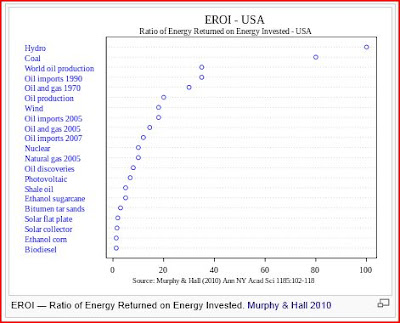
In terms of energy returned on energy invested (EROEI, or EROI), biofuels generally seem very poor:
But as this site points out, wood gas has some advantages: "Converting biomass to a liquid fuel like ethanol or biodiesel can consume more energy (and CO2) than the fuel delivers. In the case of a wood gas car, no further energy is used in producing or refining the fuel, except for the felling and cutting of the wood. This means that a woodmobile is practically carbon neutral, especially when the felling and cutting is done by hand."
It can even make sense in the more elastic terms of money: the UN Forestry Department did a study in 1986 and looked at power generation for a sawmill, using wood waste generated on site so that there was no purchase cost. The savings were significant:

As the sawmill example shows, there is plenty of mileage in intelligent problem-solving at the local level, and there is no one-size-fits-all solution. Long-term and big-picture planning are needed, but subsidies and other kinds of central government interference can skew cost-benefit analyses and result in misallocation of resources.
Of course, one could wonder why we zoom about so much in the first place:
 All original material is copyright of its author. Fair use permitted. Contact via comment.
Nothing here should be taken as personal advice, financial or otherwise. No liability is accepted for third-party content, whether incorporated in or linked to this blog; or for unintentional error and inaccuracy. The blog author may have, or intend to change, a personal position in any stock or other kind of investment mentioned.
All original material is copyright of its author. Fair use permitted. Contact via comment.
Nothing here should be taken as personal advice, financial or otherwise. No liability is accepted for third-party content, whether incorporated in or linked to this blog; or for unintentional error and inaccuracy. The blog author may have, or intend to change, a personal position in any stock or other kind of investment mentioned.
In terms of energy returned on energy invested (EROEI, or EROI), biofuels generally seem very poor:

(source: Wikipedia)
But as this site points out, wood gas has some advantages: "Converting biomass to a liquid fuel like ethanol or biodiesel can consume more energy (and CO2) than the fuel delivers. In the case of a wood gas car, no further energy is used in producing or refining the fuel, except for the felling and cutting of the wood. This means that a woodmobile is practically carbon neutral, especially when the felling and cutting is done by hand."
It can even make sense in the more elastic terms of money: the UN Forestry Department did a study in 1986 and looked at power generation for a sawmill, using wood waste generated on site so that there was no purchase cost. The savings were significant:

As the sawmill example shows, there is plenty of mileage in intelligent problem-solving at the local level, and there is no one-size-fits-all solution. Long-term and big-picture planning are needed, but subsidies and other kinds of central government interference can skew cost-benefit analyses and result in misallocation of resources.
Of course, one could wonder why we zoom about so much in the first place:

Subscribe to:
Posts (Atom)